UI/UX DES INV 190
Team Members: Jarrod Schnapper, Clara Park, & Roanna Lim
Background
Users & Research
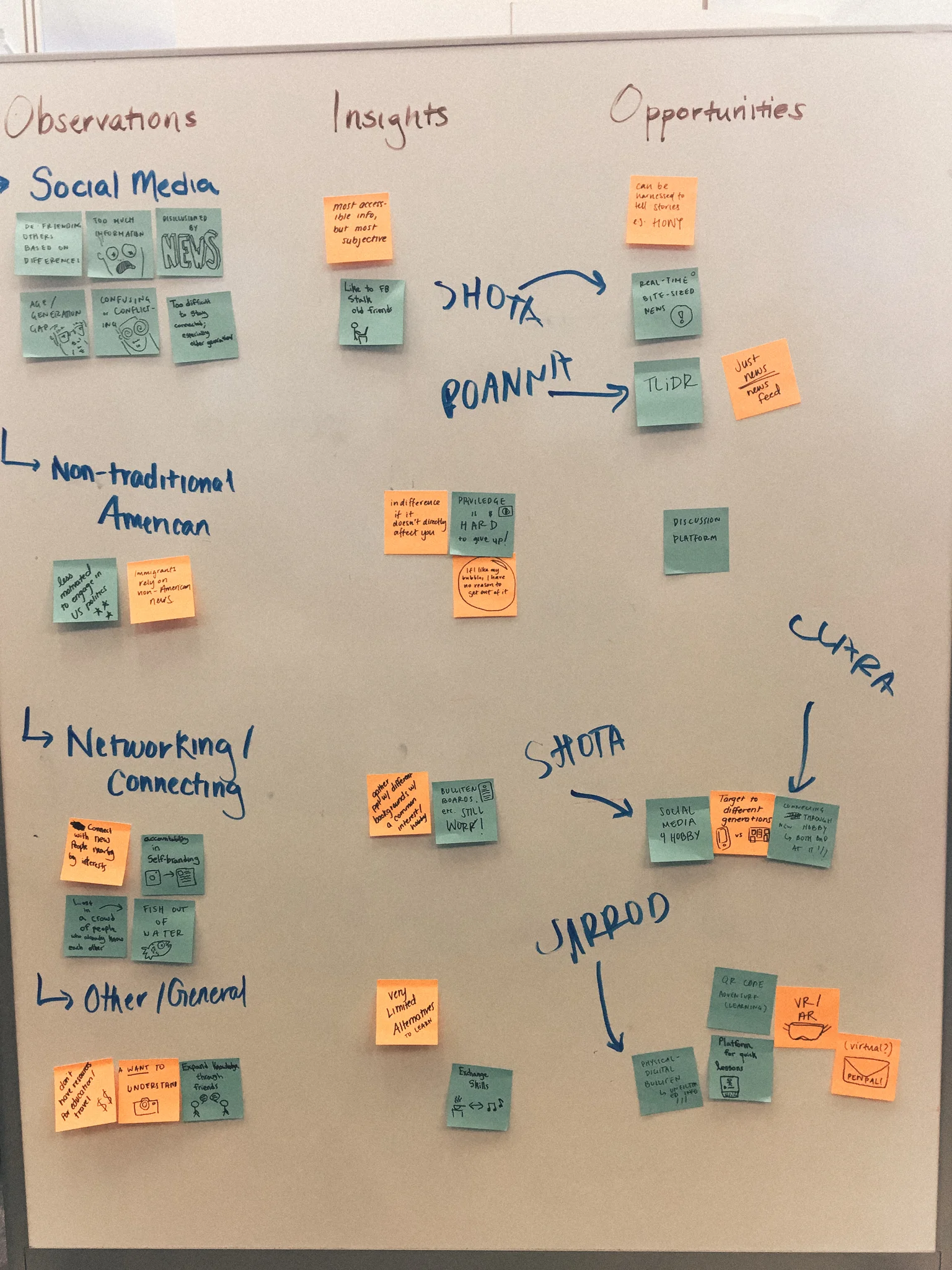
Our group conducted contextual research on a user group ranging from first generation foreign Americans of 55 years old, to College students in their twenties. We interviewed based on their social habits, point of interest, mental and emotional states during the daily lives, social media, and interactions with media/news outlets.
The Problem
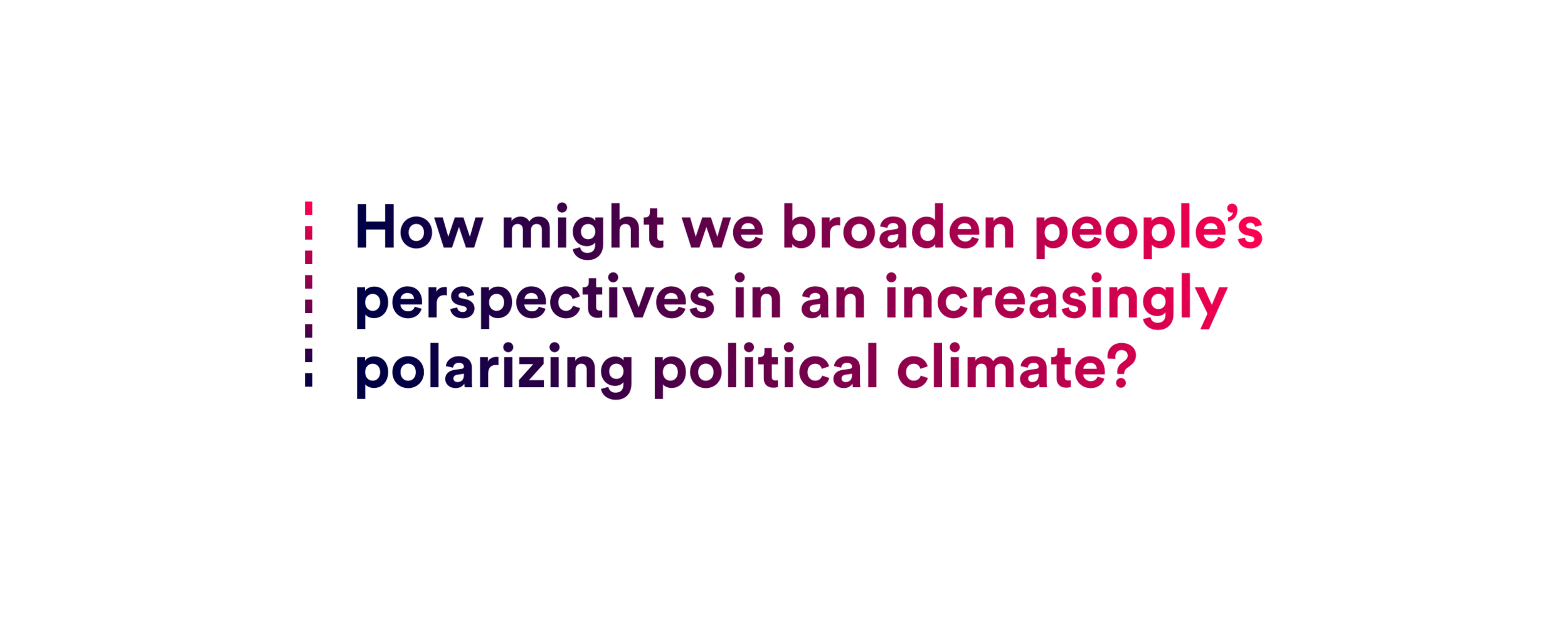
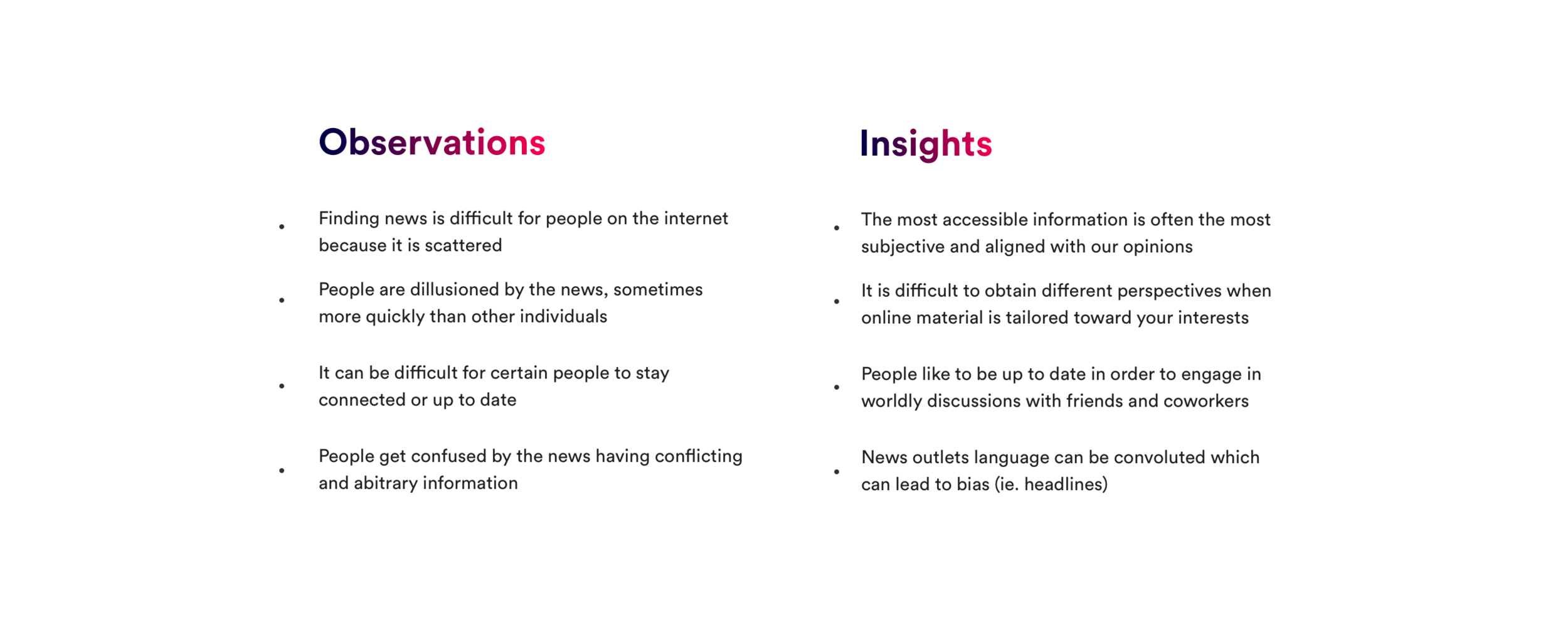
Learning about new world view points is frustrating & difficult, especially as America enters this new uncertain age, news is confusing. There is so much going in the world of politics, education, race, & more. Especially when it comes to this new era of alternative news, it can be extremely tiring to follow along with the burgeoning informational world around us. It’s hard to get outside of our own mentalities & develop empathy for new opinions, viewpoints, & personalities. So, we developed this question to during our design research to figure out what direction we were going to take this deep seeded challenge.
Top Design Concepts
Original Final Concept
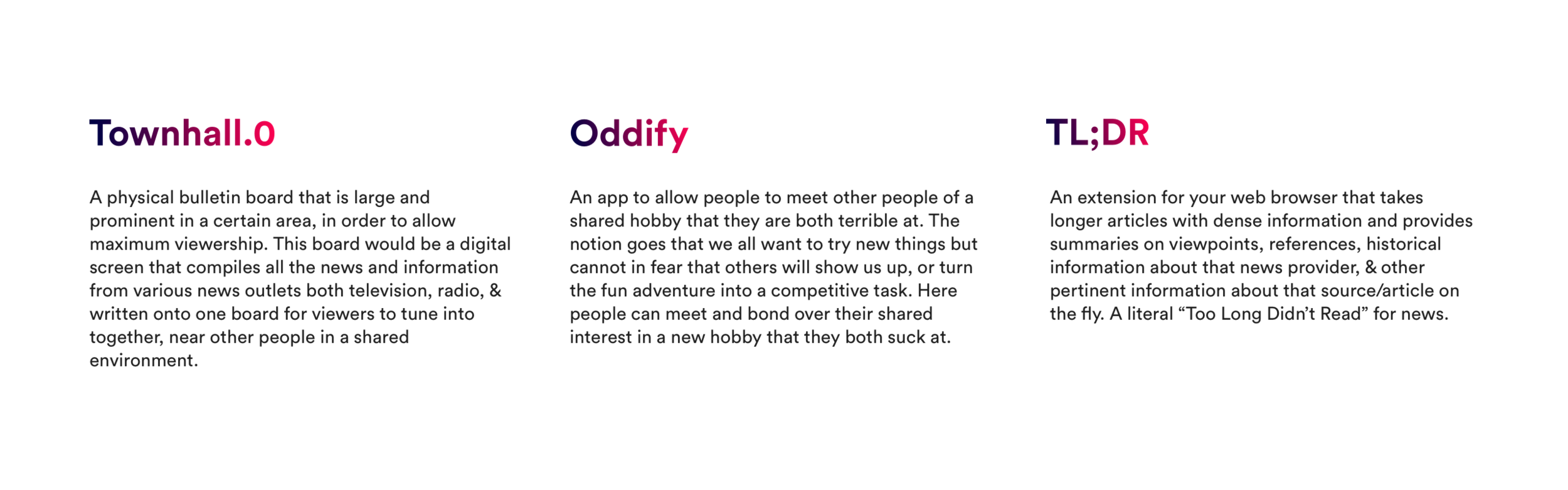
Originally our product was focused on individuals with not enough time in their day or with a lack of willpower or resources to get highly involved in the news. Yet, our notion of bite-sized news articles didn't feel compelling enough. People whom are already disinterested in the information would continue to be disinterested regardless of how short of snippet we provide. This idea of push notification news with bite-sized headlines to keep users informed wouldn't be enough to entertain these individuals needs, so we decided to pivot towards more active members in the current political divide as our main target user groups.
Pivot & Final Solution
Getting news constantly isn’t the issue. It’s how it’s being given to us. It shouldn’t be forced onto us & it also shouldn’t be spoon fed. We need a better understanding of all viewpoints, opinions, & movements in order to engage intelligently in this growingly polar political climate.
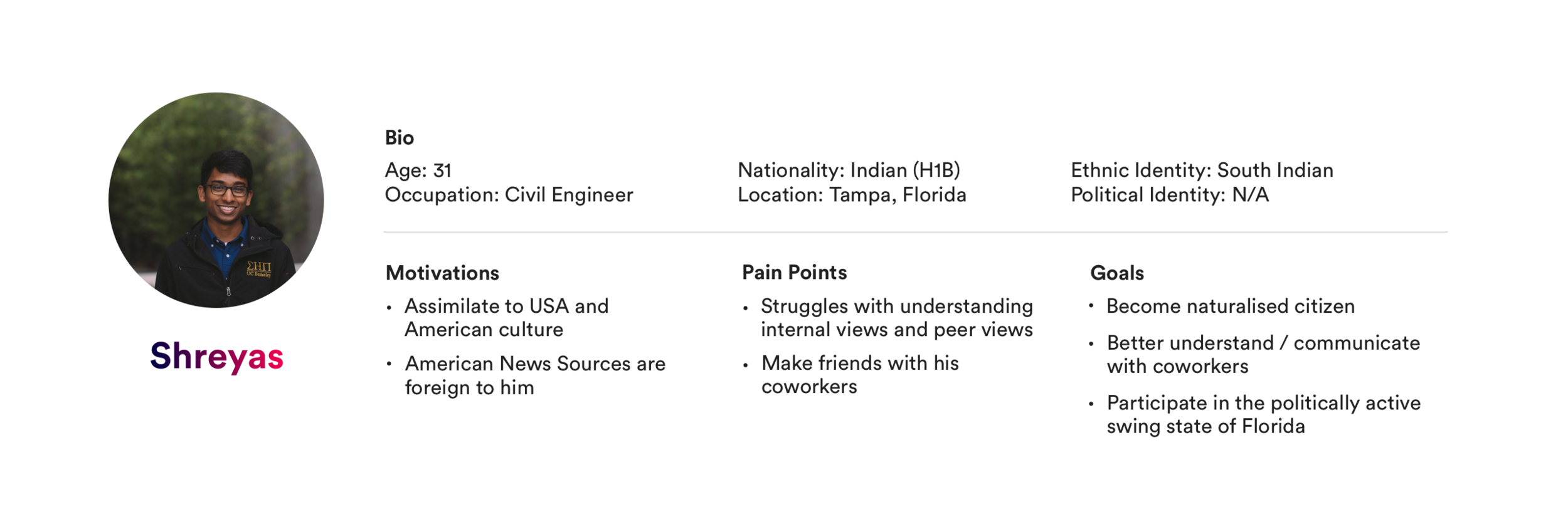
Personas
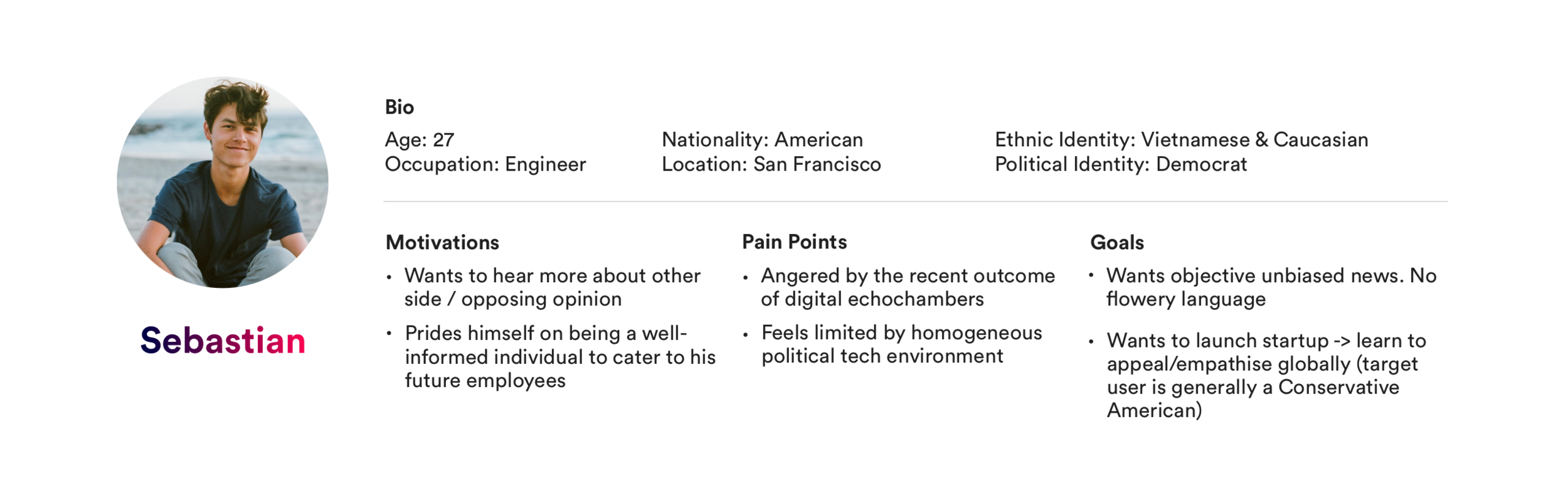
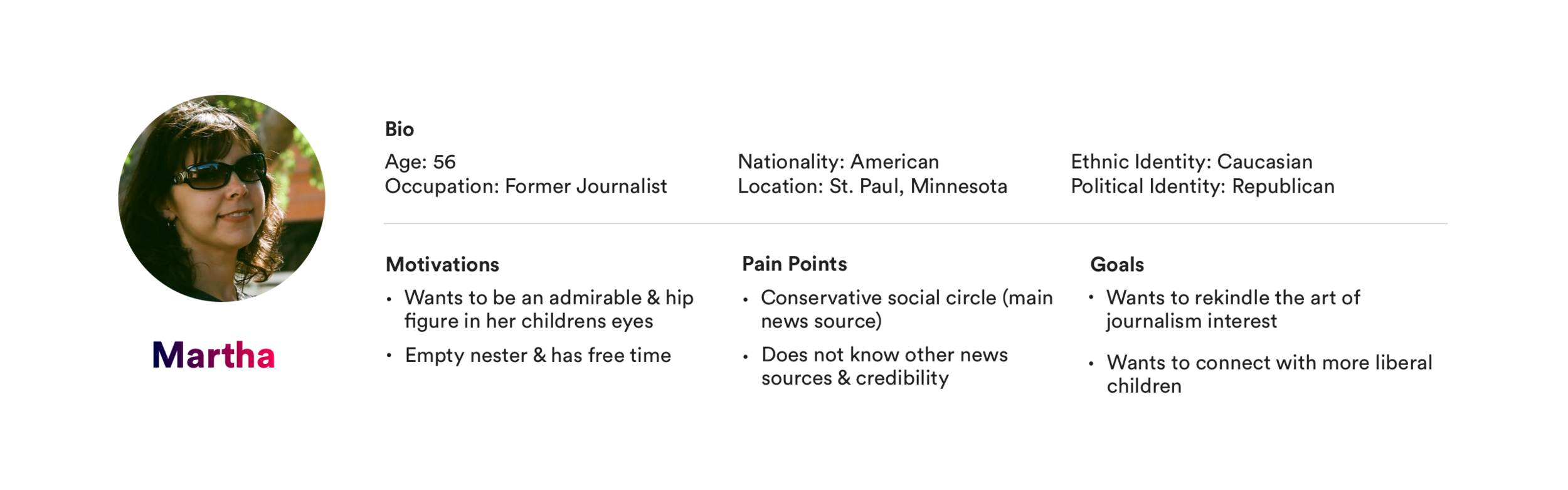
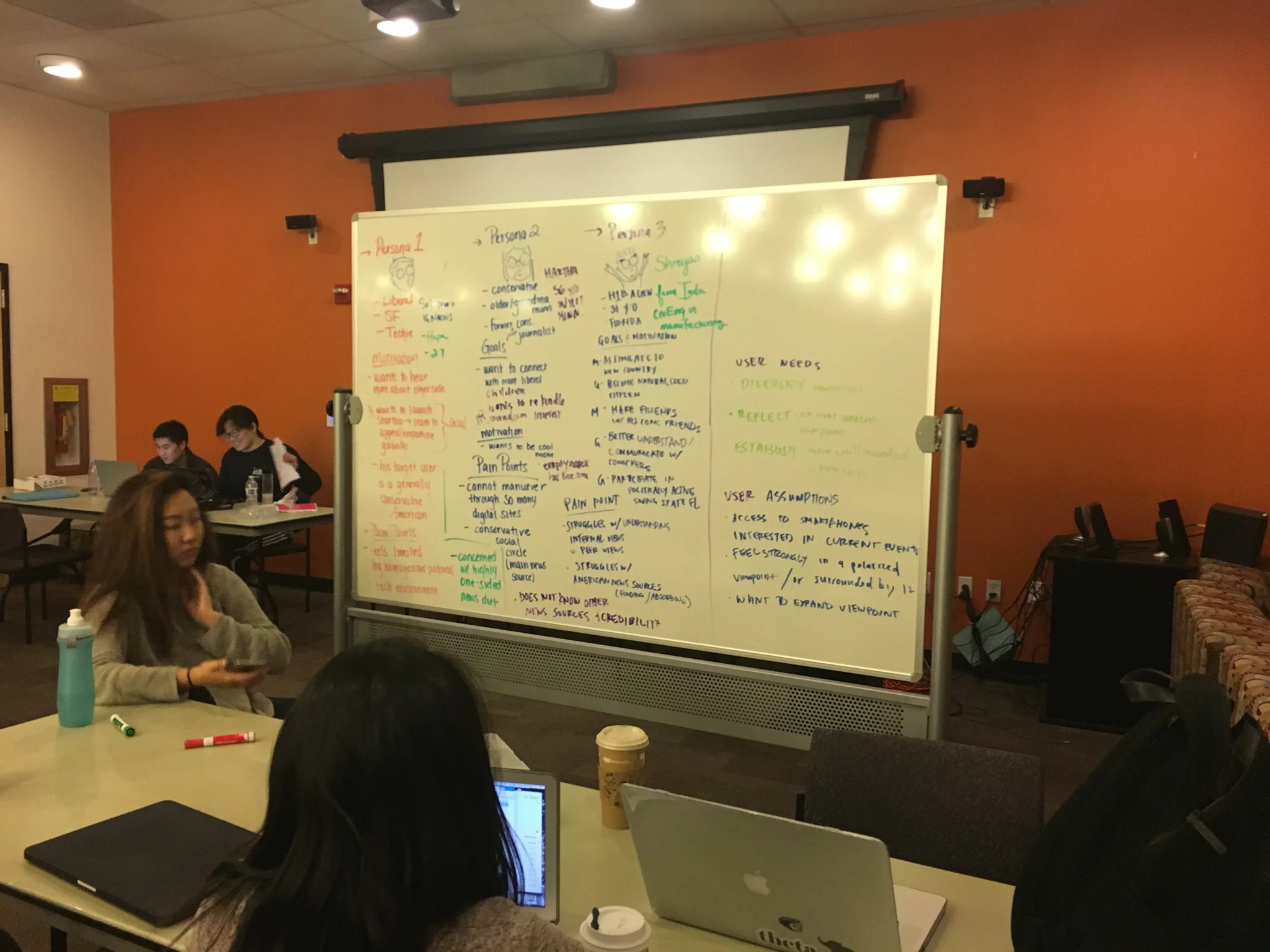
We hope to target the young adult category to the older middle-age range in order to tackle the issue being well-informed in very opinionated work environments and friend groups, specifically people whom are already actively engaged in the political news but would to delve deeper into converse opinions. Likewise, these age ranges tend to live busy lives with their careers absorbing much of their time, so having a tool that requires little input of attention for high output of information would be beneficial for their type of lifestyle.
Competitors

Allsides – High investment, Medium to High impact
AllSides provides different resources to help educate people on different political stances on a variety of issues. But with the number of resources and articles they pull, requires high investment from the reader. These readers will have already decided they want to learn about other political stances and will already know which key issues they are interested in learning about.
TrendHunter – Low investment, low impact
Does not require much user investment besides swiping between the two sides, but doesn’t offer opportunities of education beyond that. There is no tagging system to sort articles based on issue and there is no rating system for how they sort.
Quartz – Medium Investment, Medium Impact
Quartz’s iOS chat-based app sends you in-app messages about news around the world. It provides a list of questions a user may have while reading the news and uses a chat-bot to answer these questions. It also has an option to receive information about a different event. Users can select different notification options, ranging from Rarely to several times Daily or even an update about Markets using a Haiku.
Our Platform – Low Investment, High Impact
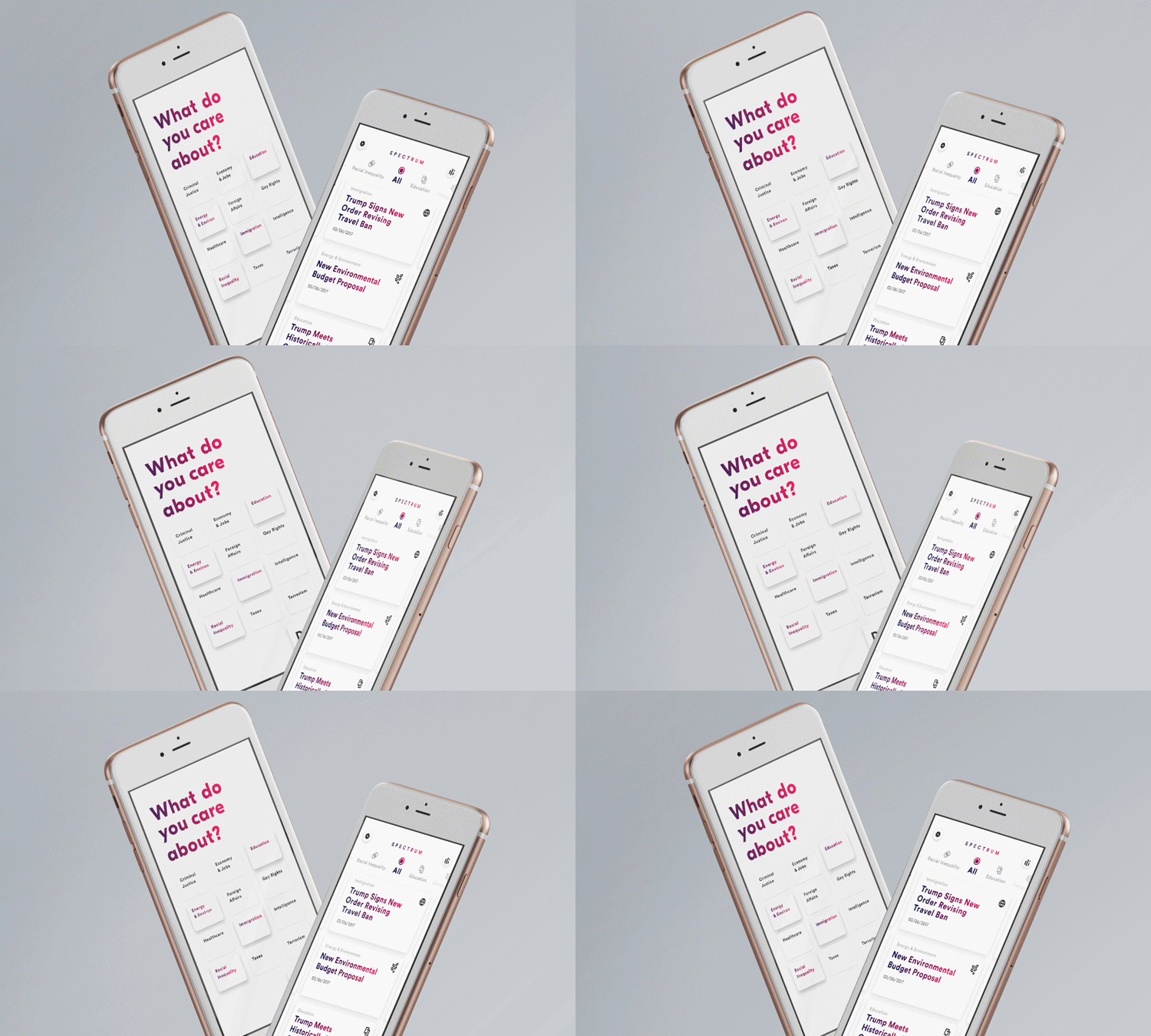
By means of our system we allow users to ingest information continuously with optional choice to invest time & effort into the information. Since it is mobile optimized & provides continuous updates our application provides a low investment, high impact platform to get users informed about issues while also giving them overviews of other news outlets in a slim, form-fitting manner.
Final
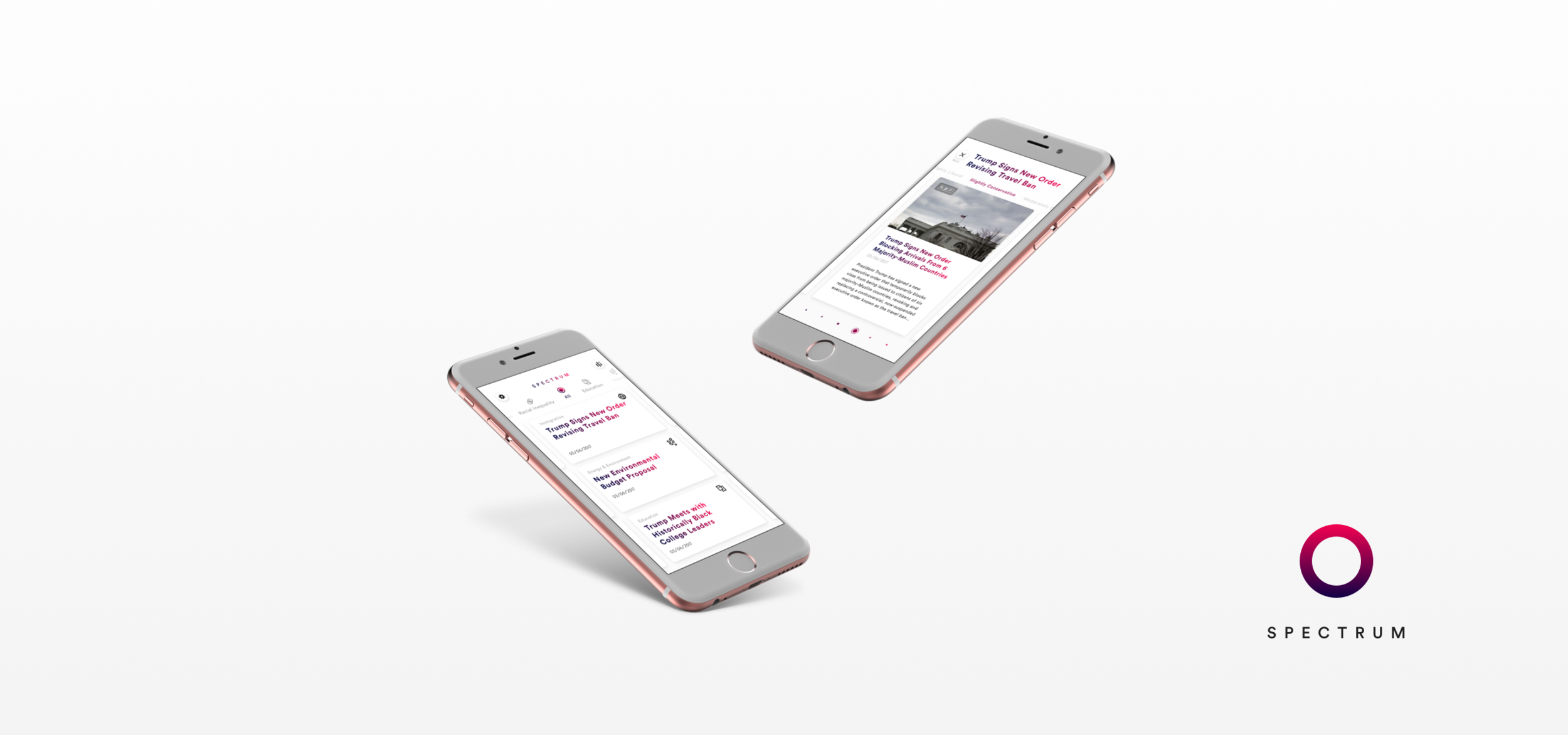
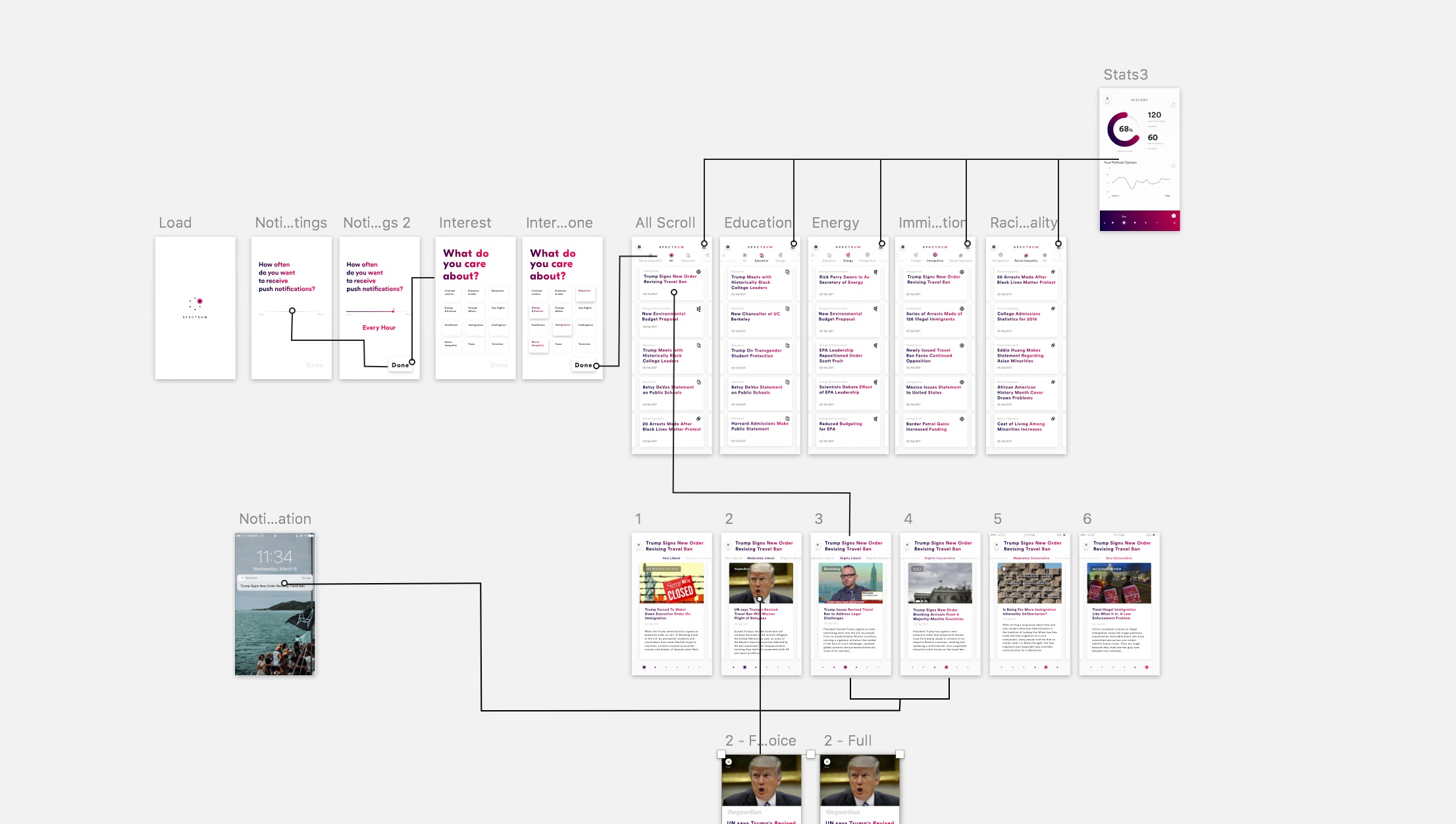
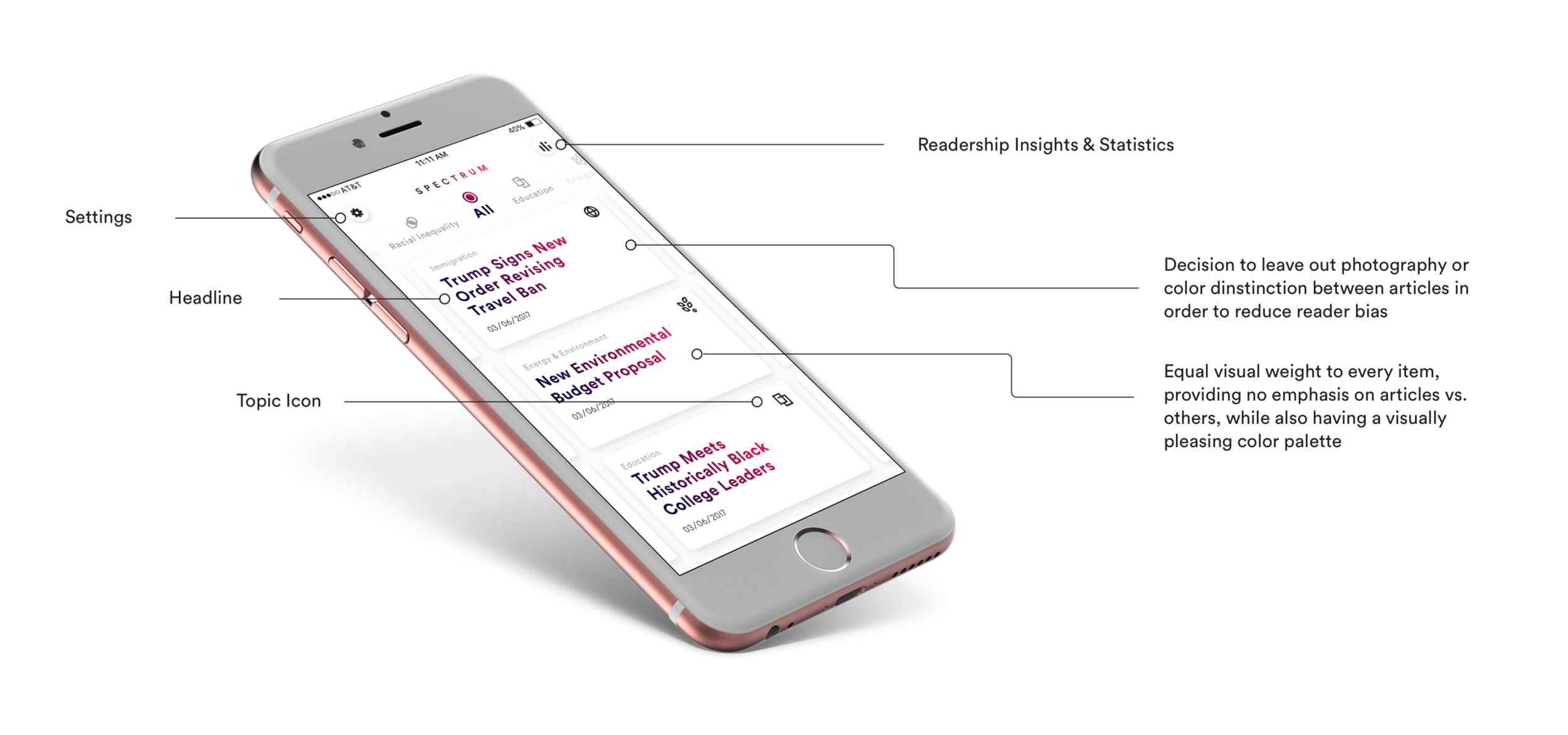
Tackling biased information is hard. Even headlines have language that carries weight & meaning in every utterance. So the best way to learn more about other opinions & digest news from a greater perspective is to take in information from the spectrum of outlets news providers & sources. Spectrum provides a packaged notification with a simple headline that attempts to aggregate 6 different headlines from varying news sources. These sources can then all be viewed with categorical bias based on article’s publisher history & specific article content.
How it Works
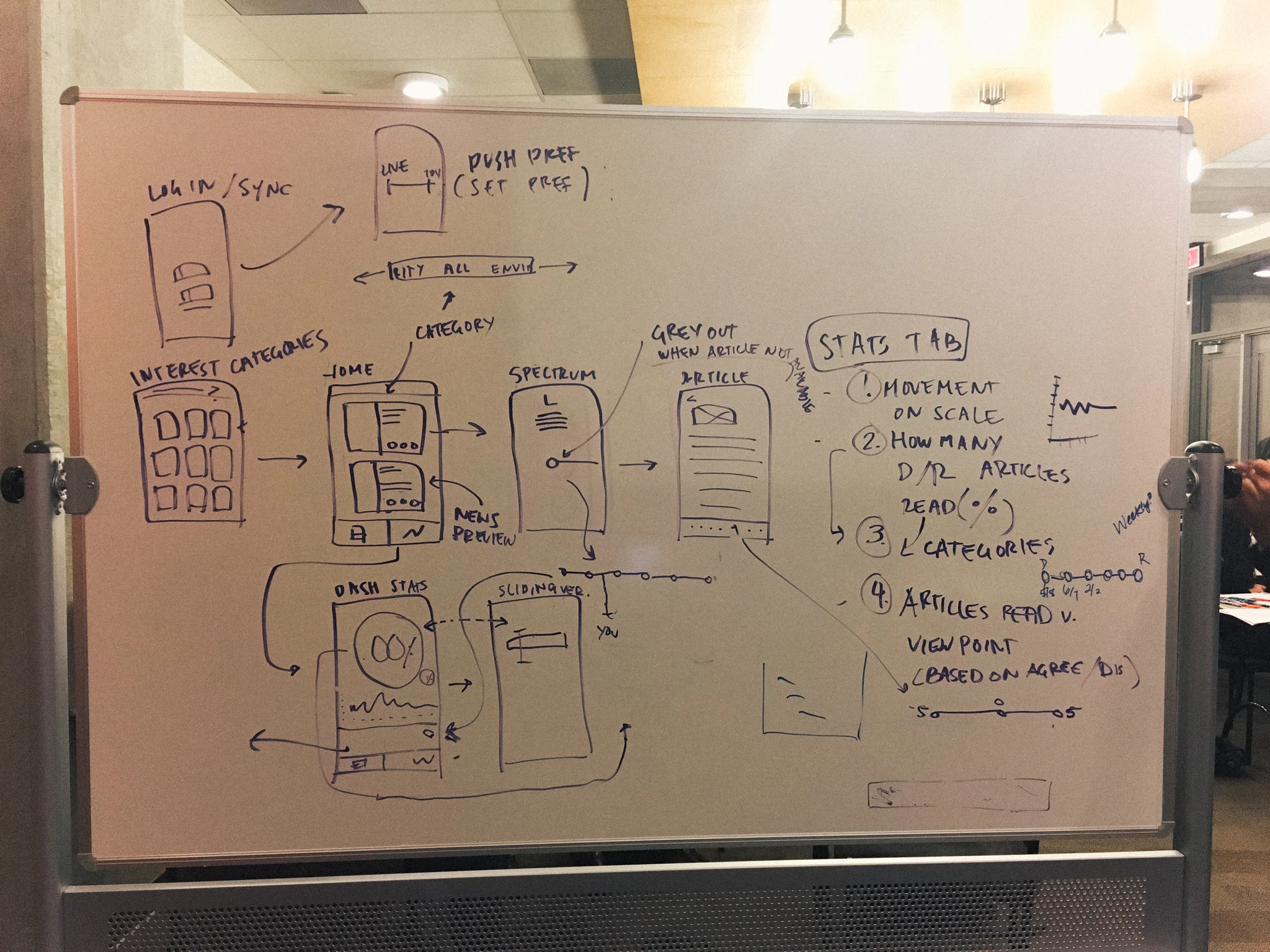
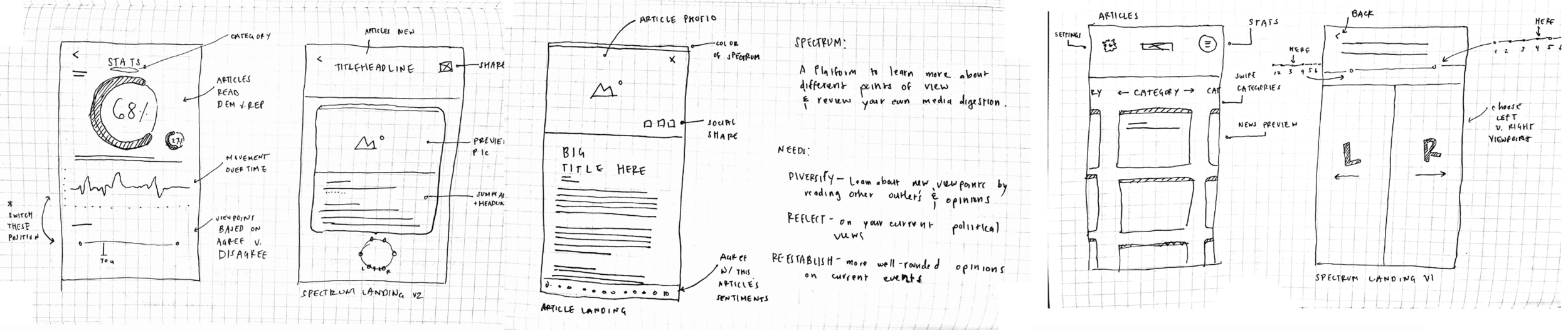
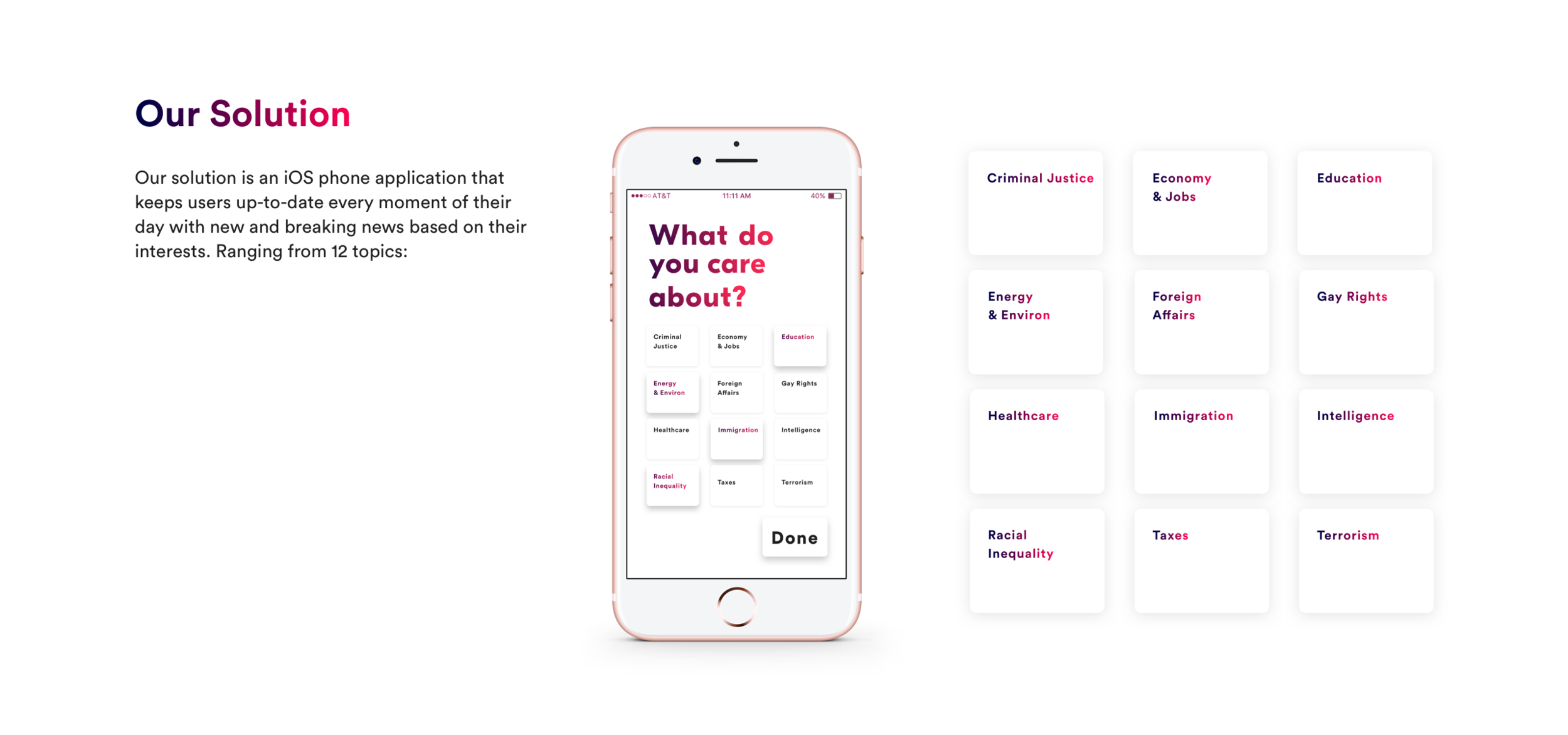
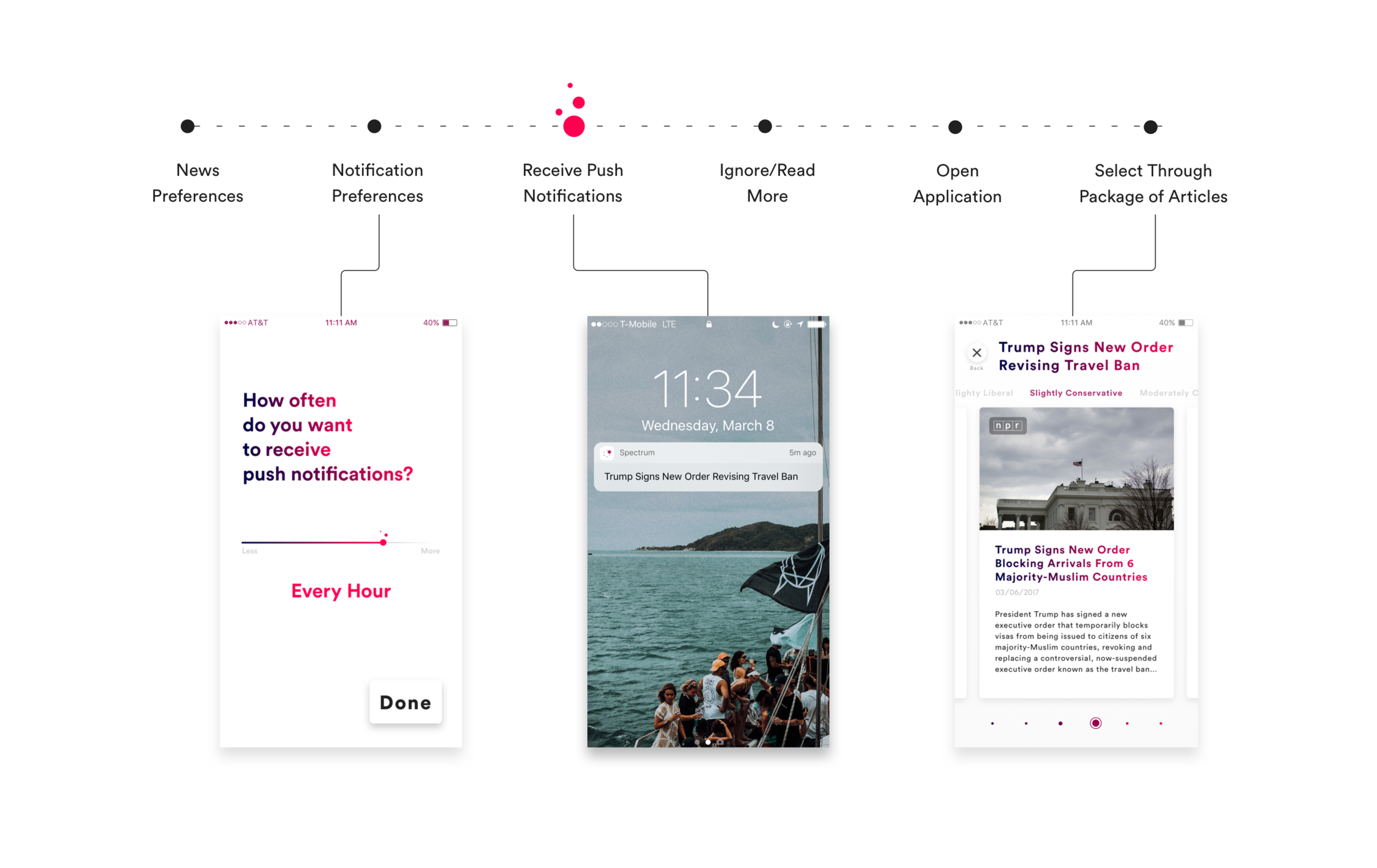
After downloading the application, users will go through an on-boarding screen in order to select their primary interests, preferences on how often they want notifications, & how they want those notifications sent to them. Then users will receive Push messages based off of their selected preferences. When Push notifications pop-up, users can decide either to ignore the notification or open the application to see a list of articles with a sliding scale of 6 articles with liberal to conservative leaning biases. We wanted to emphasize that there is no true middle & that opinions must be formulated by one’s own perspective, rather than us telling them.
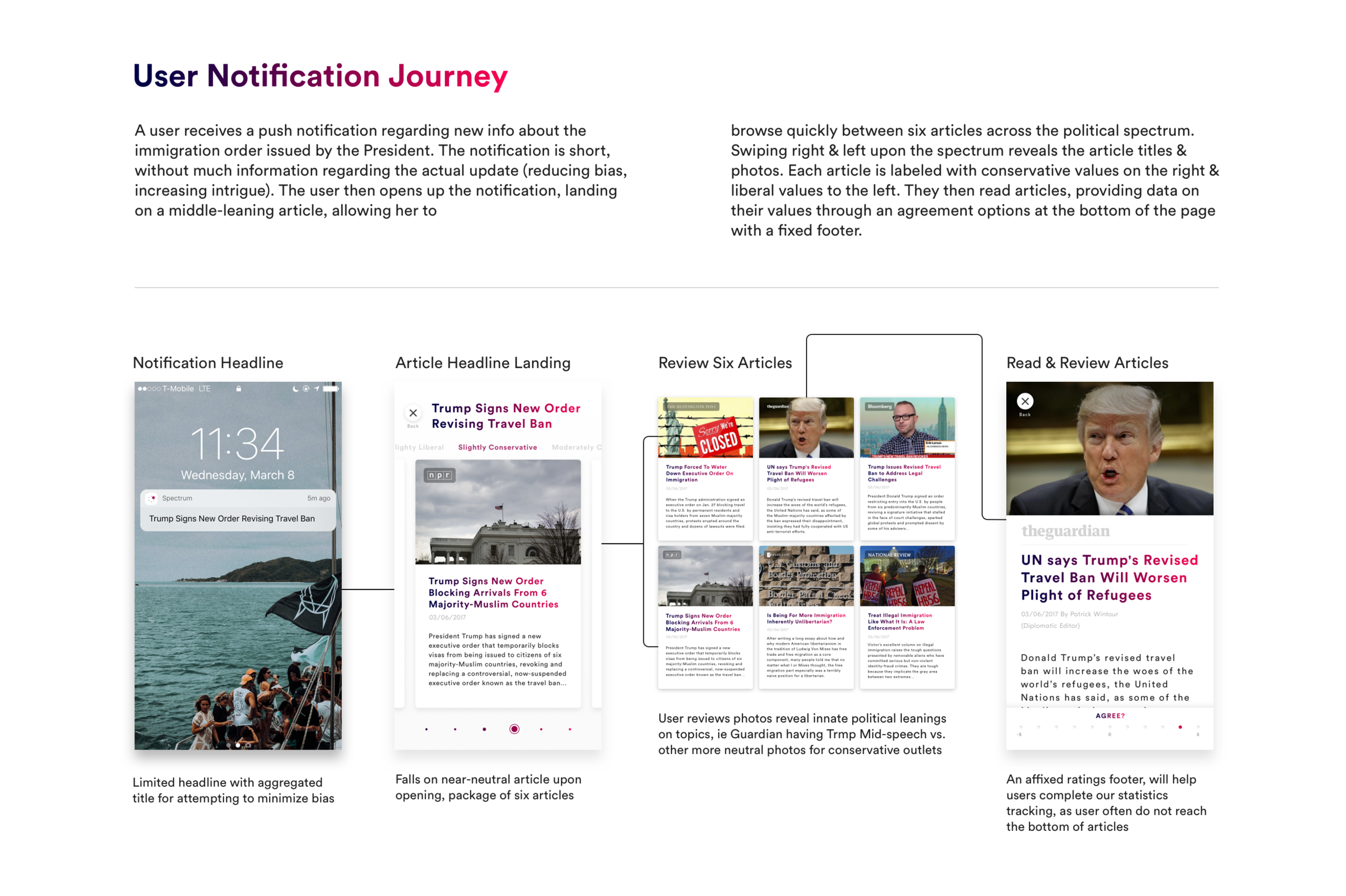
Sample User Notification Journey
User Needs & Goals
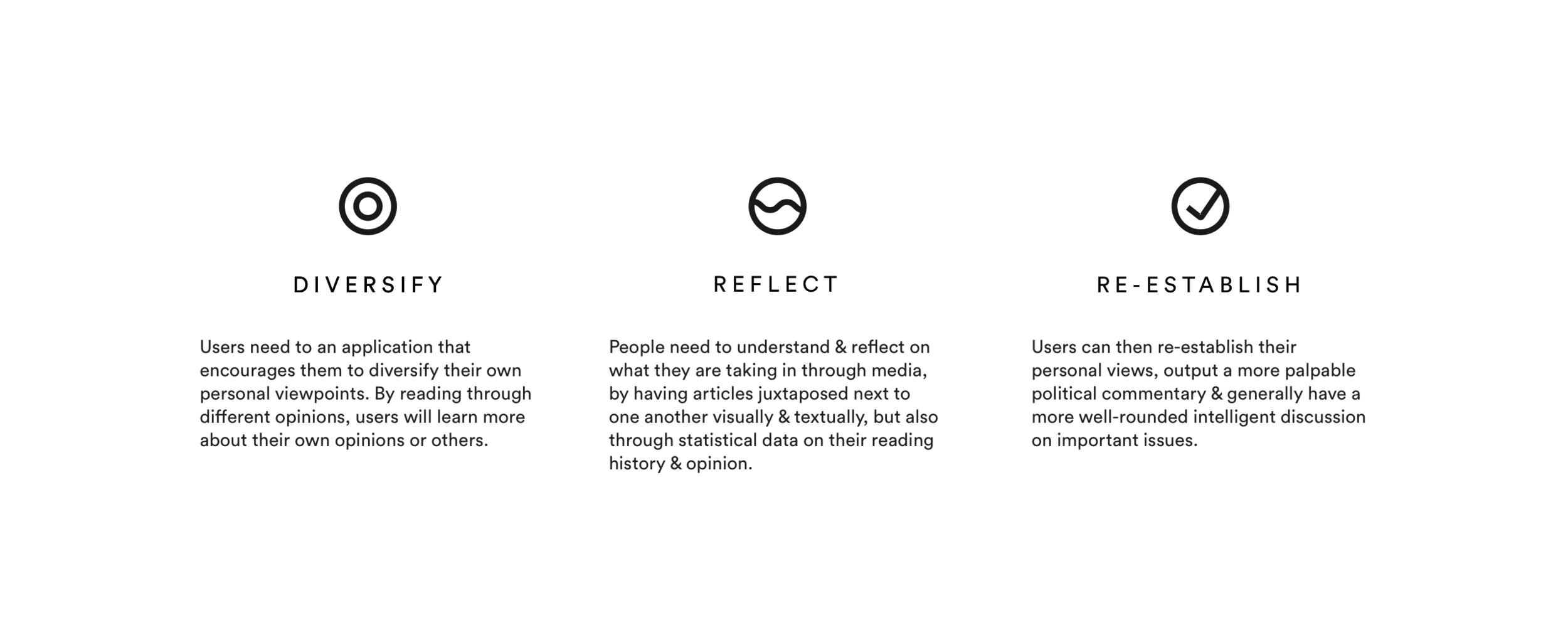
After coming down to the problem we aimed to solve through our mobile platform, we came to three core ideals that our users required when it came to having positive & productive outcomes with our product.
Interactive Prototype
Improvements
Multi-Dimensional Statistics
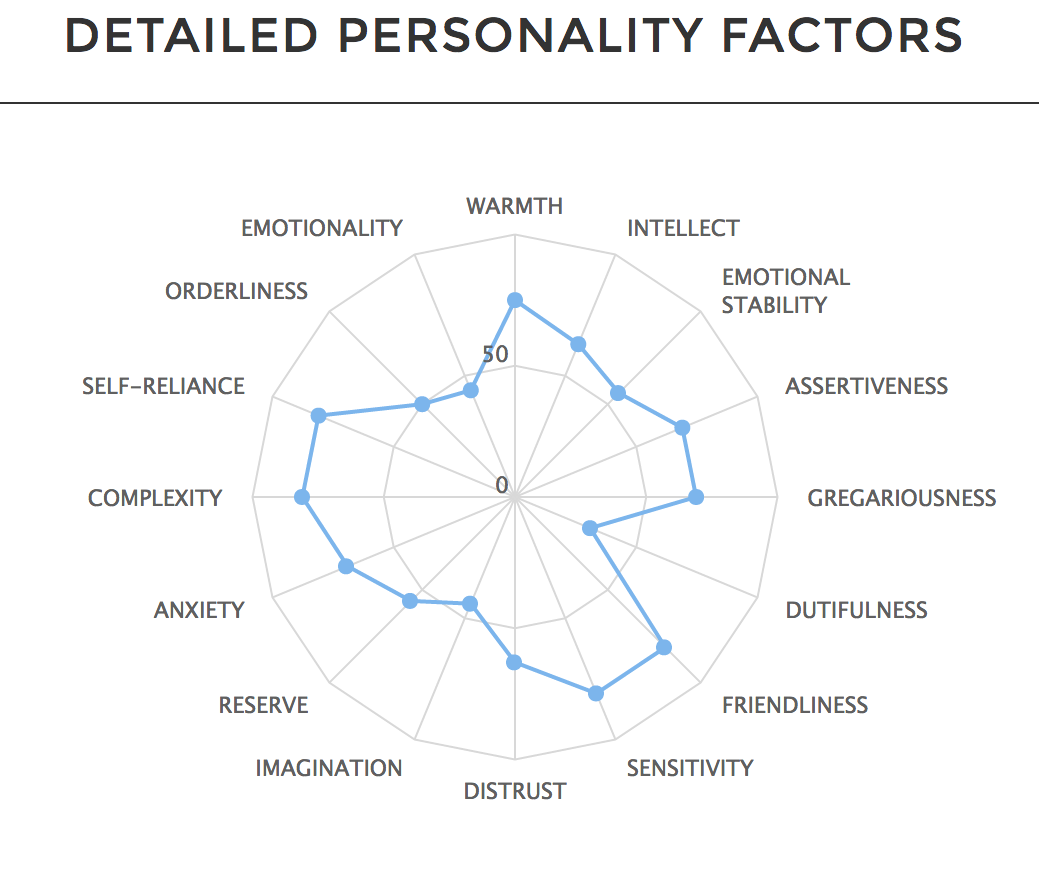
An example of the method used in other diagnostic tests to provide better representations of individuals.
Our current method only surveys individuals based on how they agree with articles based on the articles political leaning. This algorithm would take in two major inputs, the rating of the article based on -5 to 5 scale & the liberal v. conservative rating of the individual articles. A calculation would be made per rating based on these two factors, which would average out to the users political leaning over time. Yet, it's odd to classify people in this two dimensional methodology of 1 v. 1 or that there would only be two parties. This contributes to the narrative of divisiveness & "other"-ness. Instead, I hope to come up with a better multi-dimensional system that would help classify individuals based on either topic category or traits intimately linked to political associations instead.
Randomization of Landing Article

Currently our application format ships users 6 articles packed together, which becomes an issue upon shipping the package, as our system will automatically represent one article on screen without an intermediary screen, which is alarming for a system attempting to escape bias. So we are then presented with new four options at the moment, all of which decide upon choosing slightly conservative/liberal:
1) Dice-Roll : This method would visually represent & inform the users that there is a randomization of the incoming landing screen, to help gain their trust, letting them know exactly our method of attempting to decrease bias.
2) Choice : This option would present two near-neutral articles at the forefront & allow the user to have one pop up first & fill the screen. Sort of a split screen with a slide to one side if it is chosen.
3) Opposing Viewpoint : The user will be given random articles, with a slight boost in the opposing view point becoming the first article presented, in a method to increase perspective. (This could be problematic)
4) Hidden Randomization : Our we can simply provide a hidden randomization method. Users will not know which article it will land on & it will not conform to any consistent pattern.
Representing & Filling Missing Articles

Our system packages and ships articles & news as it happens with headlines that attempt to aggregate information from other articles, attempting to mediate between all outlets. When breaking news occurs, headlines will be generated by our application that are provided manually which would be problematic when the user attempts to open packages of these articles, as there still needs to be time for news outlets to publish, our system to classify, & then for the application to serve. So by this manner, our news system would need to have an ability to push news with an ability to host the package with missing links, so users can return in the future to read up on the what the larger headline indicates.
Lessons 📔
Bias is inescapable, we're naturally embedded into a relative world that can't be objective much of the time
Photos add to any application experience, but designing to reduce "bias" is difficult because we have connotations with color, hierarchy, & photo